After reading many books on self-improvement and writing articles on various productivity techniques 📝, I like to think I have a decent grasp on the principles of productivity 🤨.
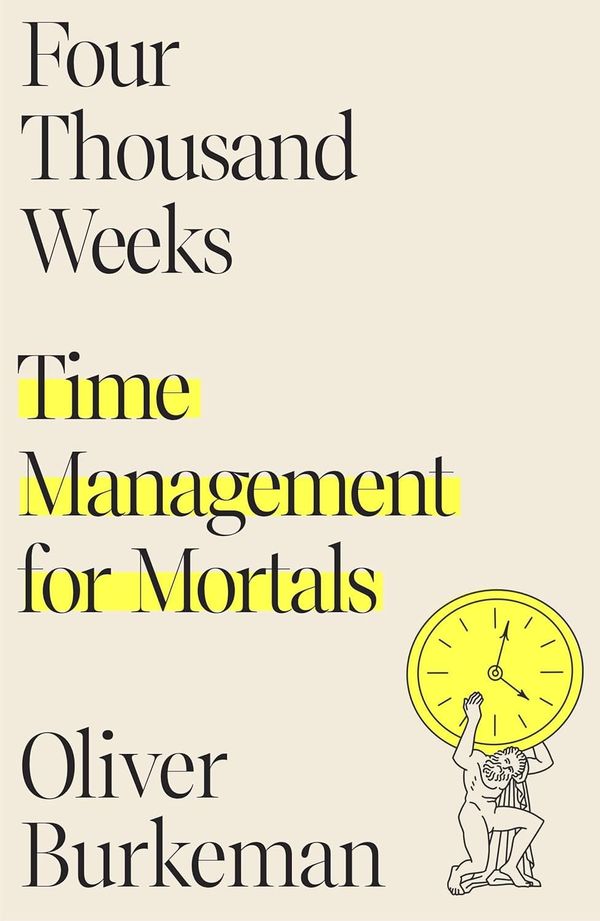
Four Thousand Weeks by Oliver Burkeman made me question everything 😅. The full title is actually Four Thousand Weeks: Time Management for Mortals, and it follows a simple premise:
We all get about 4,000 weeks to live. We can either be sad and discouraged that it’s not 1 million weeks or find peace with the time we have ⏳.
For me this book is timeless and one of my favorites because of how much it made me re-evaluate what I thought I knew 🙃.
Here are some of my takeaways:
- Life is meant to be lived. It sounds a little tacky but stay with me! It’s so easy to get caught up in the daily grind 🏇🏼, or trying to find ways to be more efficient and optimize the heck out of everything. But is that really the point ❓Burkeman calls out various “life hacks” like The 4-Hour Work Week, inbox zero, and even beloved meal replacement Soylent to shed light on an unavoidable fact:These hacks are all meant to save us valuable seconds, but we usually end up using the time we save to just do more work 🤦🏻♀️. And even once we do save those seconds, we feel even busier than we did before!
- Your patience can be power. Why are we so impatient with 10 seconds on the microwave but okay with 2 hours in the oven ⏲️? When I read this line, I felt immediately attacked! Working in medicine, especially in emergency medicine 🚑, it can be incredibly difficult to be patient. But sometimes things are out of our control, sometimes the only thing we can do is be patient. As Burkeman states so eloquently, “The trouble with attempting to master your time is that time ends up mastering you.”
- Don’t let what you want overshadow what you have. While I was reading Four Thousand Weeks, I knew it was only a matter of time before I got to the part where Burkeman reminded us that we could die at any moment 💀. So as much as we might want to optimize every moment of our lives, none of those moments are guaranteed. While that can be a scary or morbid thought 😵, it can also be a liberating one. The sooner we realize we won’t be able to experience every single thing life has to offer, the sooner we can enjoy the experiences we do get 😌.
- Your focus is a finite resource. Unlocking productivity requires a certain degree of focus, and this can be easier said than done. Fortunately, Burkeman didn’t attack some of my favorite strategies for maintaining focus like the Pomodoro Technique. He also didn’t suggest ways to rid ourselves of every distraction in life…after all, distraction can be what allows us to respond to a baby that’s crying 👶🏻, or jump out of the car of a honking car in the street 🚗. Instead, Burkeman chose to focus (see what I did there? 😋) on how focus can make life more enjoyable. I love the metaphor Burkeman used to capture this idea: The finest plate at a Michelin-starred restaurant might as well be a cup of ramen noodles if your mind is elsewhere 🍜.
- The imperfect things sometimes matter more. Sometimes we focus so much on getting the perfect picture that we forget to savor the moment 📸. Sometimes we push so hard to be good at a hobby that it stops being a hobby and starts to feel like work 🎸. But maybe it’s okay if that picture is imperfect, or if that hobby skews a bit more towards being embarrassing. After all, it’s the fact that we’re giving something our attention that gives it value, rather than chasing a perfect outcome.
Although Four Thousand Weeks by Oliver Burkeman declared war on a lot of my core beliefs about productivity 🤺, it was a refreshing take on the topic and has been one of my top reads. I recommend it to anyone in search of the latest and greatest productivity hack, just don’t be surprised if your feelings get a little bit hurt along the way 🥲.